
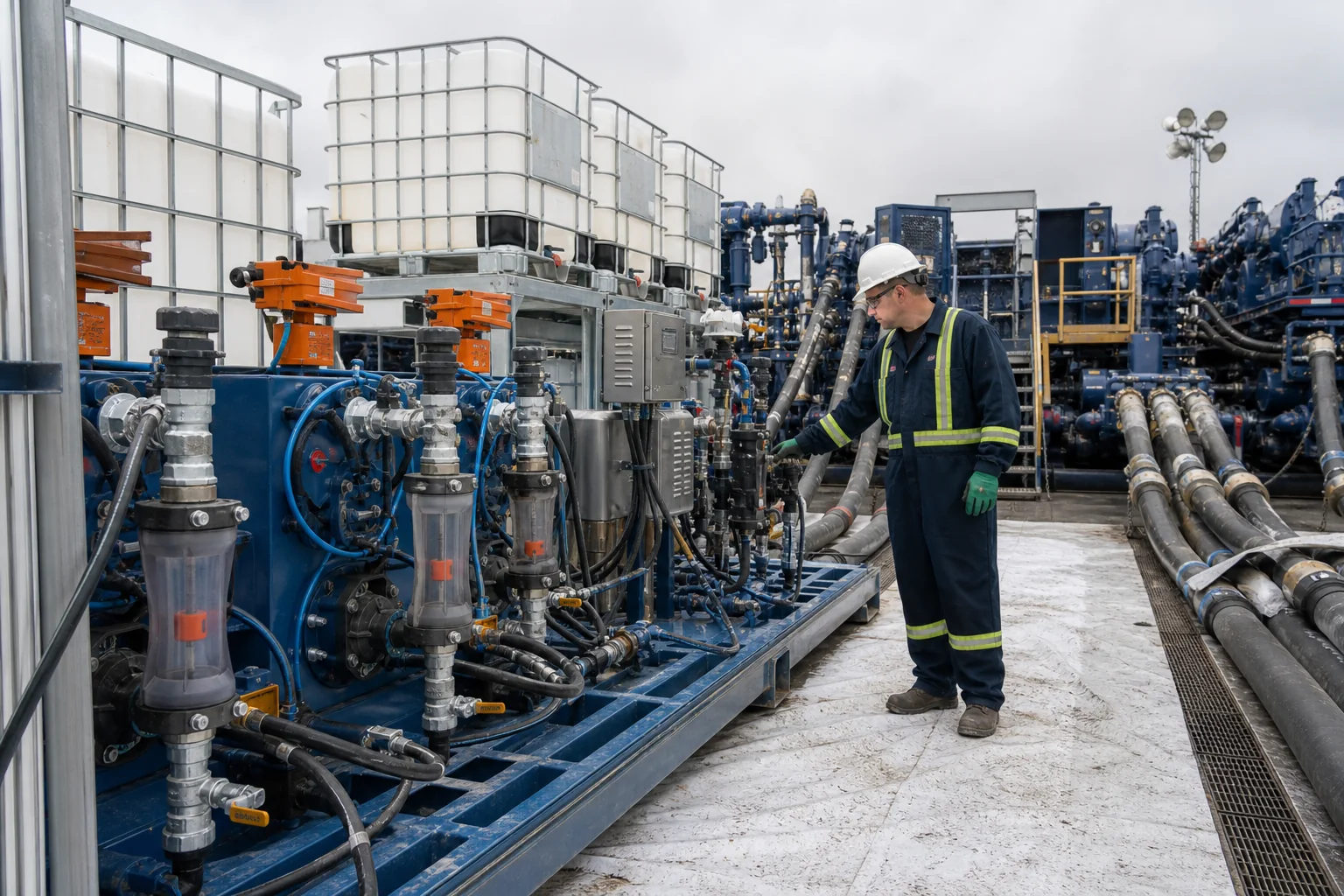
Capture the event
Record rate, pressure, water, stage, chemical rates and equipment changes.
Do not adjust several variables first.
Verify product identity
Check tote or bag, lot and approved code.
Exclude substitution.
Check pump delivery
Measure calibration, suction, pulsation, blocked lines and injection point.
Commanded rate may not equal delivered rate.
Inspect hydration
Review temperature, chemistry, mixing and residence time.
Slow development can look like low activity.
Validate pressure instruments
Check baseline, range, zero and acquisition.
Sensor drift can imitate chemistry failure.
Review shear
Trace pumps, valves and restrictions.
Compare paired samples where possible.
Check additive sequence
Look for changed chemicals or order.
Compatibility faults may be stage-specific.
Close the cause
Change one factor, verify restored response and document controls.
Retain the corrective record.
Pressure-response interpretation and release record
A defensible friction-reducer decision begins with a specific hydraulic question. Record base-water source and analysis, temperature, pipe geometry, target flow condition, clean-water differential pressure, injection point and available hydration time. Include the current product and other planned additives. Without those controls, a percentage from another loop or water cannot establish field suitability.
Compare a blank, the incumbent and coded candidates at equal active addition. Keep water batch, temperature, pump, pipe, flow condition, differential-pressure range and timing consistent. Record the complete pressure trace from injection through the chosen endpoint. Repeat critical points so normal instrument and preparation variation remains visible, and preserve raw data rather than reporting only the best reduction number.
Follow the polymer through the surface system. Note tote or dry feeder, metering calibration, dilution, blender mixing, residence time, high-pressure pumps, valves and restrictions. A candidate that develops slowly may reach a strong final loop response after the field opportunity has passed. Excess mixing can also damage extended polymer chains, so preparation failure and mechanical degradation must be diagnosed separately.
Approve a bounded operating window rather than a universal dose. State water chemistry, temperature, active addition, response time, flow condition and acceptable differential-pressure trace. Review additive compatibility, filter behavior, handling and cleanup beside pressure performance. Revalidate after meaningful water, rate, equipment, additive-program or product-identity changes.
Plan field confirmation before the sample arrives. Define baseline duration, stable-rate requirement, chemical sequence, acquisition interval, operator observations and stop conditions. Hold other variables steady when operations allow, and document unavoidable changes. A short pressure improvement during a changing rate is not the same as a controlled comparison.
Close the work with a release record shared by operations, laboratory and purchasing. Connect the approved sample code to active basis, formulation or product form, COA, SDS, packaging, quotation and receiving checks. Retain the water analysis and pressure trace. This prevents a later shipment or new water blend from being accepted on the name of a product whose tested conditions have been lost.
Before commercial release, compare the candidate at the anticipated low and high operating conditions, not only at the easiest midpoint. Note pressure stability, time to response, pump behavior and any visible incompatibility during each run. Define who reviews deviations and which changes require another water sample or loop test. These controls make the recommendation useful to procurement without presenting laboratory evidence as a guaranteed field outcome.