
Request compatibility for the actual program
Name the commercial biocide, scale inhibitor and other additives planned for the water system. Include their current technical identities, addition locations and treatment timing as approved by the operator. A request for compatibility with biocide is too broad to support a reliable purchasing recommendation.
The produced-water reuse route requires particular attention to residual upstream chemicals. Record what is already present in the sample as well as what will be added during the test. Otherwise the stated blank may not be chemically blank.
Map where the chemicals meet
Describe storage, pre-treatment, blend tank, polymer addition and high-rate flow path. Contact order and dilution can affect observations. A laboratory procedure that combines concentrated products directly may not represent field conditions and may create hazards or misleading results.
Use the responsible chemical suppliers' guidance and the operation's safe testing procedure. Do not improvise chemical mixtures or infer a safe sequence from a general guide. The test should reproduce the approved dilute operating contact conditions, not create an unreviewed concentrated blend.
Build comparisons that isolate the effect
Start with representative water and a reference polymer, then compare the planned combinations under the agreed procedure. Use appropriate controls to distinguish water instability from a polymer-additive interaction. Record time, temperature and preparation conditions with every observation.
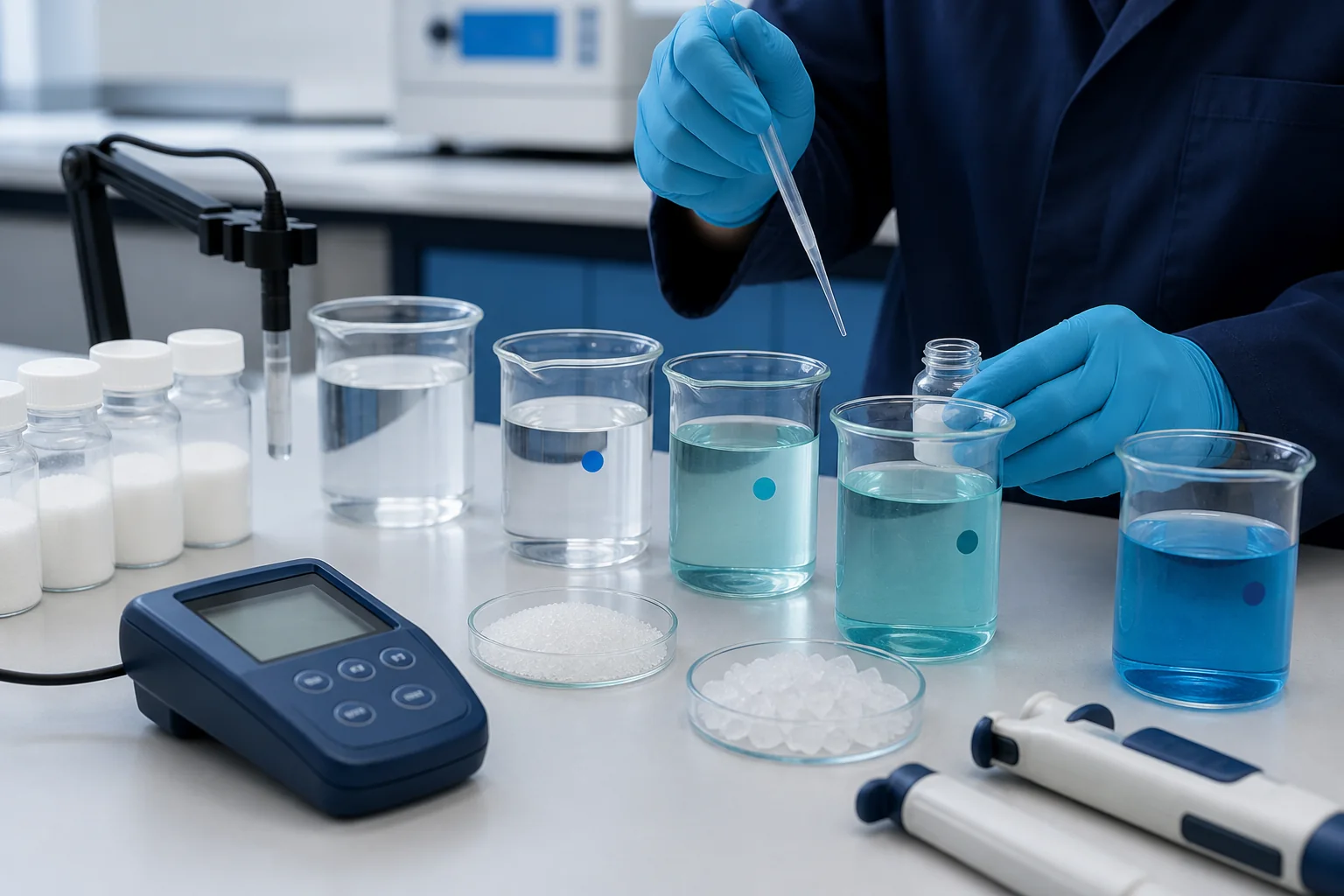
Observe haze, precipitation, foam, unusual solution behaviour and any relevant filter response. Where an interaction appears, repeat controlled conditions before blaming a component. A photograph can support the record but does not replace the measurement governing acceptance.
Confirm the hydraulic consequence
A physically acceptable mixture can still show weaker or slower drag reduction. Run the relevant pressure-response comparison with the complete package at matched flow, geometry and temperature. Include the early interval that matters in service and record the later retained response.
The troubleshooting method helps distinguish metering, hydration, water and additive changes. Do not compensate for an unexplained compatibility loss by simply increasing polymer consumption and treating the extra cost as unavoidable.
Specify limits and notification duties
Record the accepted product identities, sequence and water envelope. State which changes require review: new additive formulation, changed dosage program, a different injection location or a materially different produced-water source. Conditional approval should identify the required operational control.
Share the accepted compatibility record with purchasing and receiving so a seemingly equivalent replacement is not introduced without technical review. Avoid promising universal compatibility across all biocide or scale-inhibitor families when only one commercial combination was evaluated.
Prepare a supplier-ready request
Send the water analysis, current additive list, approved addition order, pressure-response requirement and sample schedule. Ask for a coded friction-reducer candidate and a stated rationale for screening. Keep any unavailable chemical details as explicit gaps rather than invite unsupported certainty.
Use the additive-program enquiry to obtain a bounded technical response. Application-specific chemical handling and dosing remain under the operator's qualified team and the relevant product instructions, not this commercial checklist.