
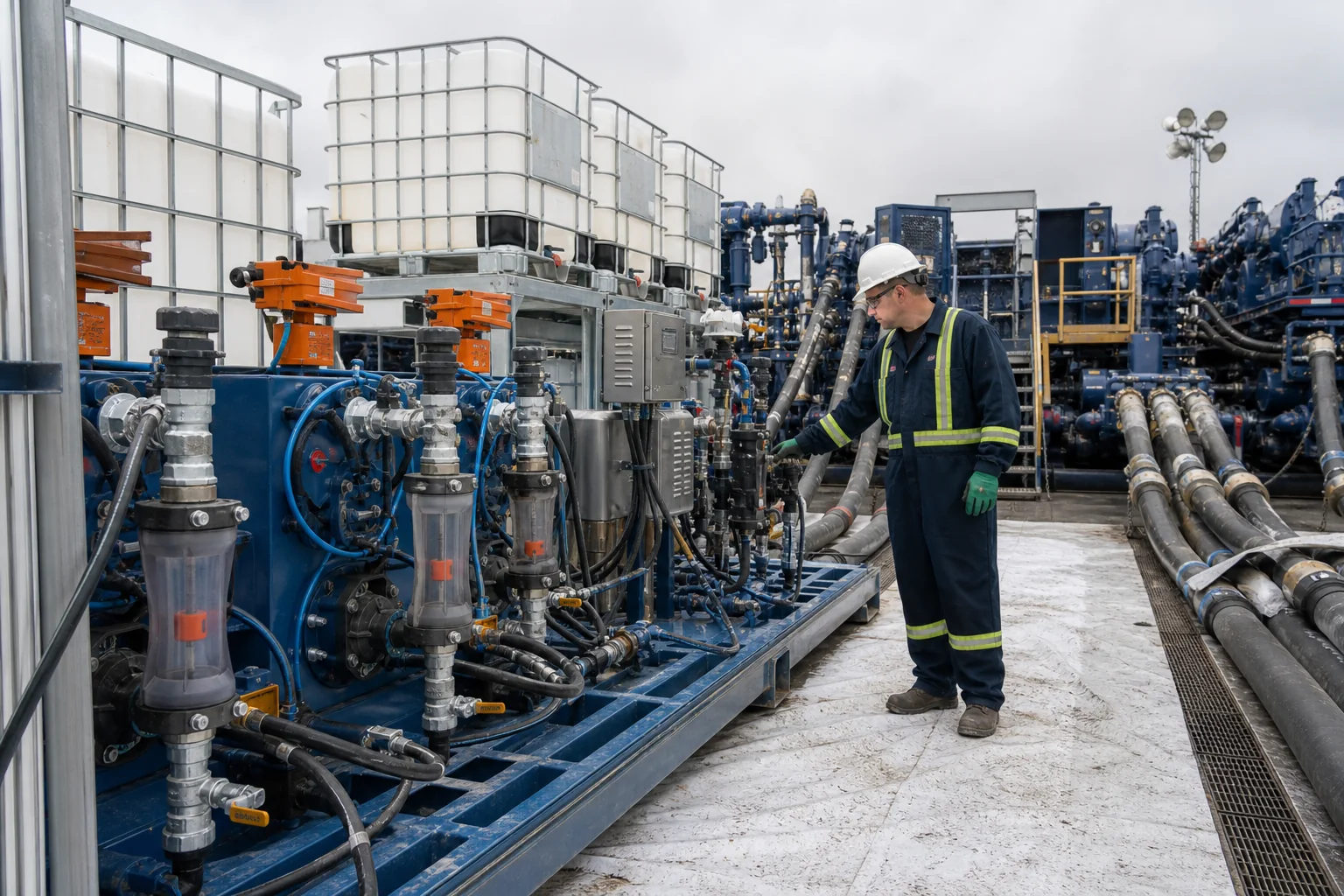
Define the pumping water
Provide source, TDS, monovalent and divalent ions, temperature, suspended solids and planned reuse percentage.
Emulsion inversion and polymer extension can change sharply between fresh water and produced-water blends.
Measure inversion speed
Inject the candidate with representative mixing and record the pressure response at short time intervals.
A strong final result may still be unsuitable when hydration is slower than surface residence time.
Run a controlled flow loop
Use constant pipe geometry, water batch, flow or Reynolds condition, baseline and differential-pressure instruments.
Report the complete pressure trace rather than one selected percentage.
Check additive compatibility
Reproduce biocide, scale inhibitor, surfactant, clay control and breaker order where relevant.
Clouding, separation or slow inversion should be investigated before field use.
Review field logistics
Confirm tote condition, pump compatibility, suction, calibration, temperature limits and spill-control procedure.
Liquid handling convenience does not replace active-basis and performance comparison.
Preserve the approved identity
Link sample code, lot, active content, carrier system, COA, SDS and quotation.
Revalidate after water, equipment, formulation or supplied-product changes.