
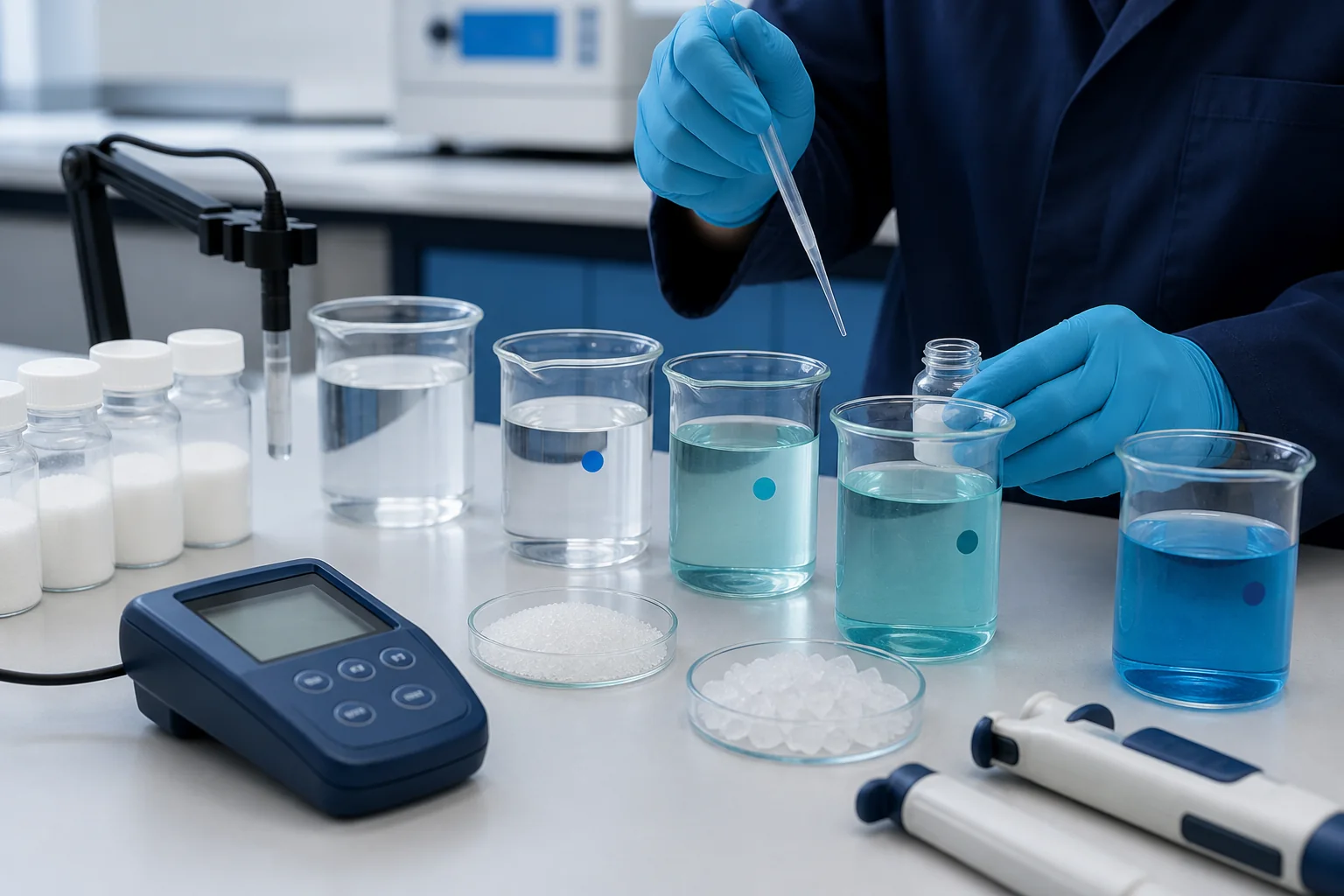
Collect representative water
Record source, time, treatment and storage.
Preserve solids and oil context.
Analyze important ions
Include sodium, calcium, magnesium, iron, alkalinity, pH and TDS.
TDS alone is incomplete.
Create a blend matrix
Test expected reuse percentages and credible difficult water.
Keep recipes traceable.
Screen physical compatibility
Observe inversion, haze, separation, residue and filter response.
Visual clarity is not a pressure result.
Run matched loops
Use identical geometry, flow, temperature and timing.
Compare early and final traces.
Include planned additives
Preserve chemical order.
Residual treatments can alter response.
Define the water envelope
State pass, conditional pass and fail conditions.
Avoid universal brine claims.
Monitor production water
Set analysis and retest triggers.
Water variability must remain visible.
Connect the test result to a purchase decision
Keep the approved water, preparation and pressure-response record with the proposed product identity. Resolve the next commercial question using High-Salinity Friction Reducer Quote: Water Data Buyers Need; Produced-Water Friction Reducer Samples: Build a Meaningful Test Panel.
The selected grade, test conditions and any operating limitations should remain traceable through quotation, trial supply and receiving. A change in water, formulation or equipment calls for review rather than automatic acceptance against an old result.
Evidence and purchasing interpretation
Separate the water's analytical description from its physical condition. Ion concentrations help define salinity and hardness, while oil, suspended matter and residual treatments can influence observations and preparation. Transport and settling can change the sample; document the received condition and avoid silently decanting a difficult field sample into an easier laboratory fluid.
Build a small, representative blend matrix with enough water for repeated critical tests. Preserve actual blend recipes and identify synthetic substitutes. Run the blank and incumbent with the same batch so a change in the water is not mistaken for a candidate effect. Observe physical behaviour and pressure response as separate outcomes.
The accepted boundary should name composition, temperature, preparation, timing and additive conditions. A pass at one TDS does not prove all waters with that TDS are equivalent. Set practical recheck triggers for source changes, residual treatment changes and the limits of the tested blend rather than assigning a universal brine-tolerant label.